
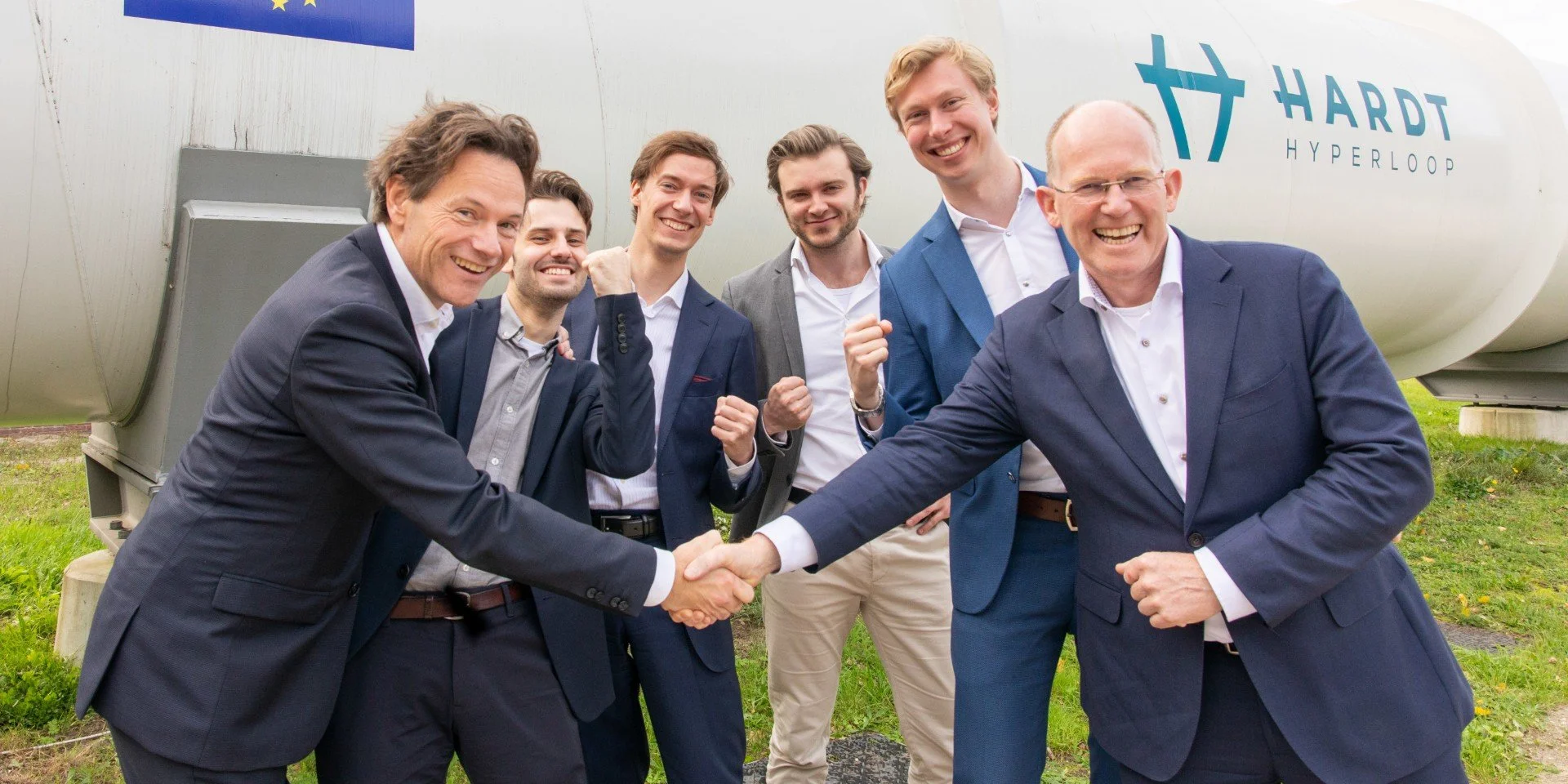

A world where distance doesn't matter
Hardt builds the core of the hyperloop: magnetic levitation, propulsion and lane switching, tested at full scale in Veendam.
See the test centreHardt started with a team of TU Delft students and built Europe's first full-scale hyperloop test facility. After the bankruptcy in March 2026, the company has restarted with a multi-million euro round led by US investor GreenRock, and its earlier backers are coming back.
The new funding goes into developing the technology, preparing the projects that were already planned and starting new ones. The exact amount has not been disclosed. Read the announcement
Hardt and GreenRock signed a strategic partnership to develop hyperloop projects across North, Central and South America. In Europe, Germany's coalition agreement sets up a national reference framework for hyperloop.
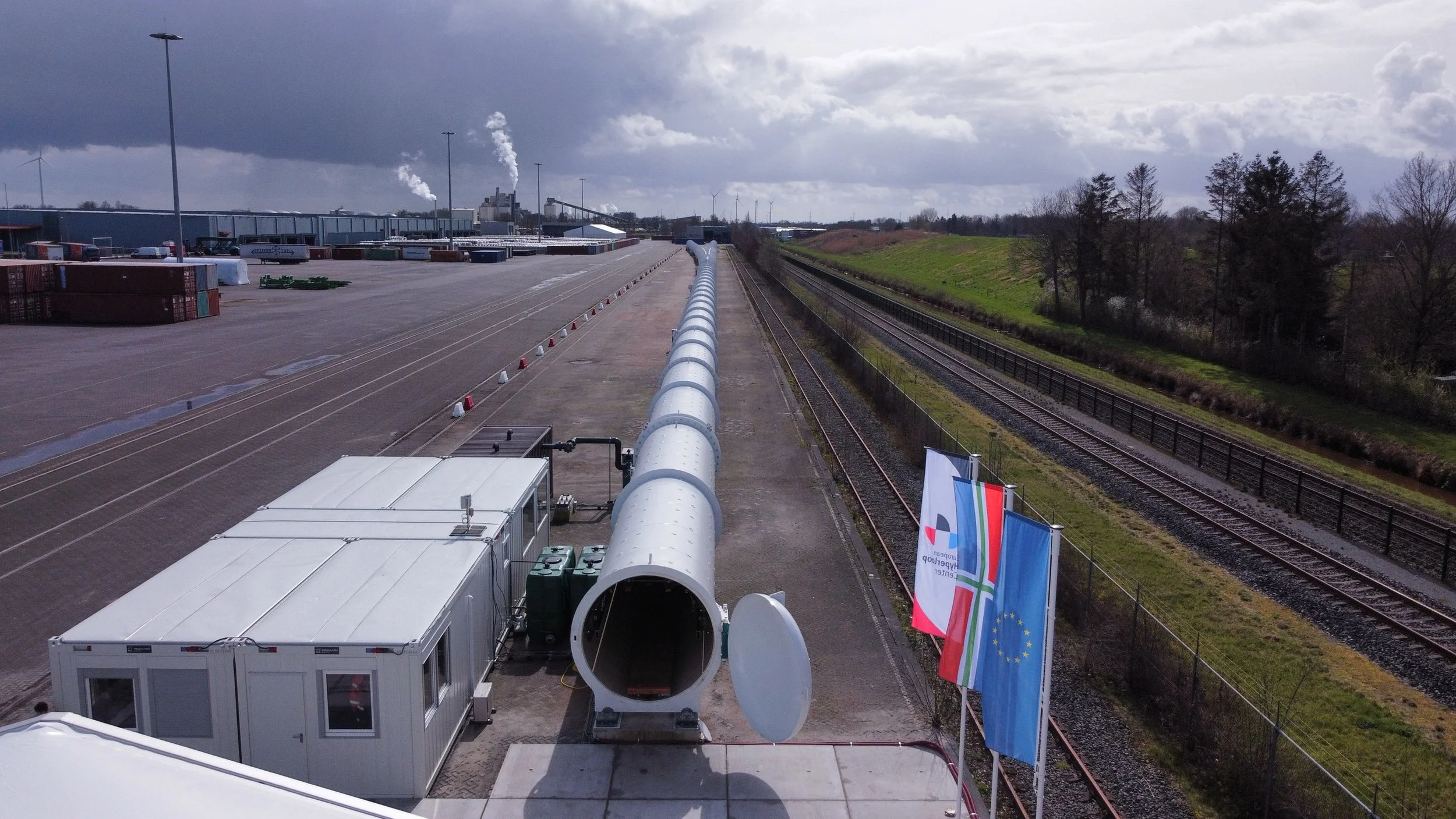
An open test facility in Veendam, the Netherlands, where Hardt and other developers test and demonstrate hyperloop vehicles. Hardt supplied its core hyperloop system.
Visit the test centreThe European Hyperloop Center
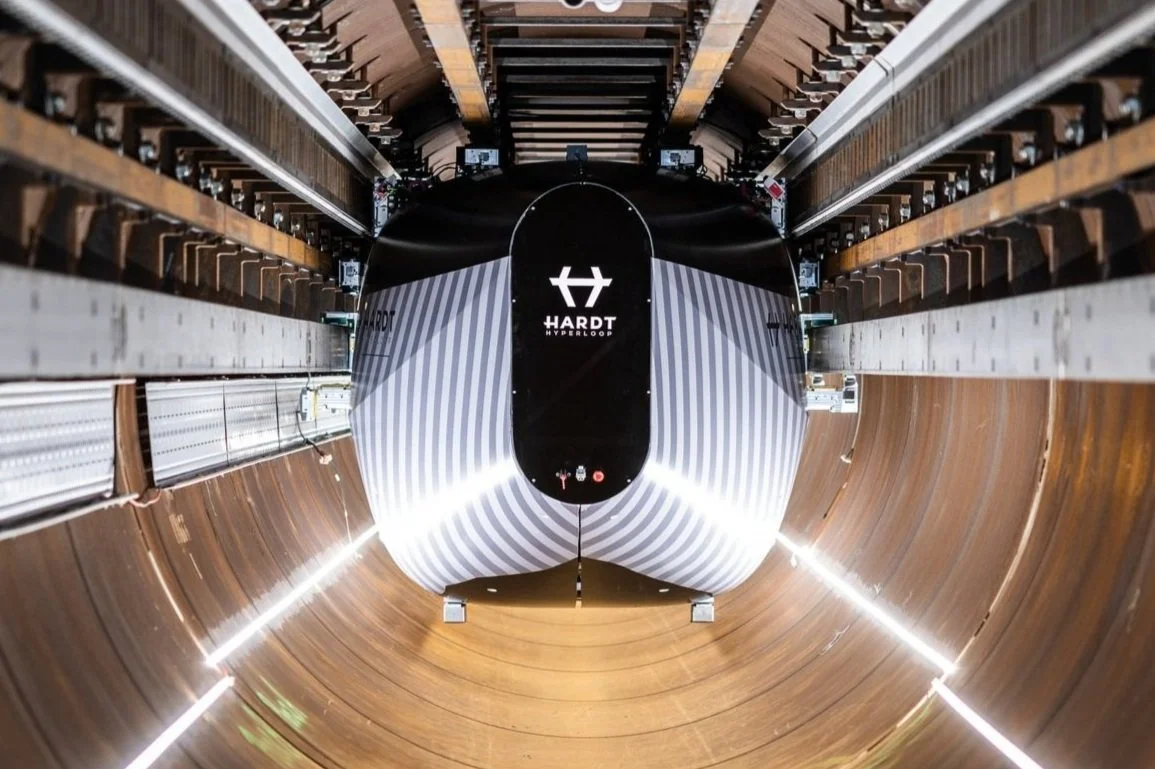
Inside the tube
A vehicle floating on magnetic fields, moving through a low-pressure tube without touching the track.
How it worksA lane switch with no moving parts
A railway switch moves steel to send a train another way. Hardt's lane switch has no moving components: the vehicle changes lanes magnetically, so the track itself stays still and passive.
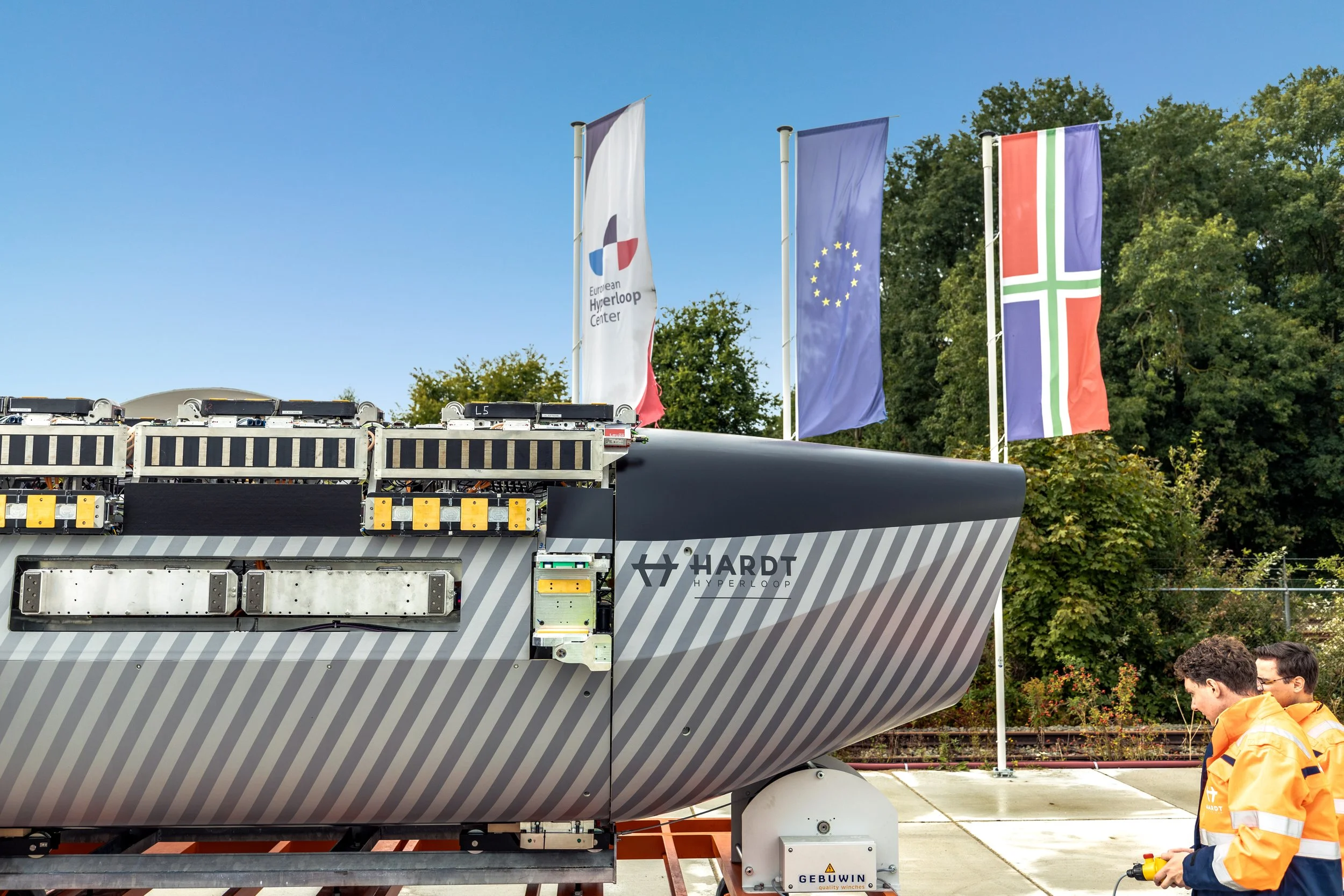
Hardt demonstrated it as a world first, next to propulsion tests up to 300 km/h on a prototype.
Talk to the engineersLevitation
The vehicle floats on magnetic fields. No wheels on rails means minimal maintenance.
Propulsion
Tested up to 300 km/h with a propulsion prototype.
Open standard
One of the initiators of the official European hyperloop standard, with an open, passive infrastructure specification.

Onboard camera still from Hardt test footage, 2019.
Pick two cities
Choose a start and a destination on the map. The panel compares door-to-door time and CO2 per passenger for hyperloop, rail and a short-haul flight.
These are estimates from the assumptions under the results, not timetables or planned routes.
Hyperloop
Train
Plane
Estimates. Route length is the straight line between city centres × 1.15 (× 1.25 for rail). Hyperloop: 500 km/h average, the average speed stated by Hardt, plus 40 min to reach and leave stations. Train: 160 km/h average plus 40 min, our assumption. Plane: 700 km/h plus 2 h 30 min for airport access, security and boarding, our assumption. CO2 per passenger-km: flight 156 g, rail 41 g (UK government factors via Our World in Data); hyperloop 21 g assumes half of rail's energy use, as Hardt states, on the same electricity.
Investors and partners in the restart
- GreenRockUS investor, lead of the November 2026 round and strategic partner for hyperloop projects in North, Central and South America.
- Perpetuum VenturesExisting investor, taking part again in the new round.
- Urban Impact VenturesExisting investor, taking part again in the new round.
- European standardHardt is one of the initiators of the official European hyperloop standard.
Build the next line with us
Three ways in, each with one clear next step.